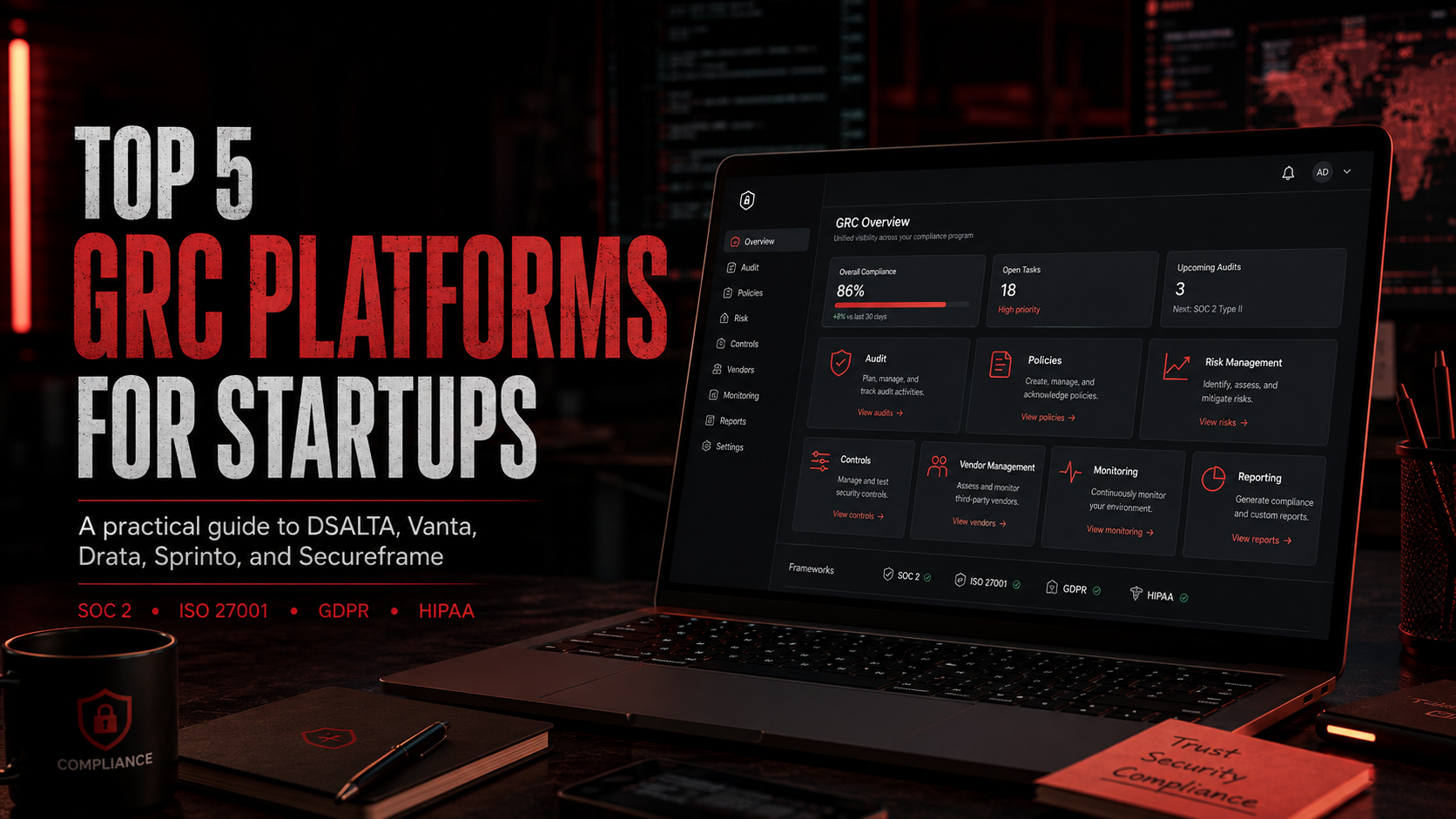
Top 5 GRC Platforms for Startups: DSALTA, Vanta, Drata, Sprinto, and Secureframe
For many startups, compliance does not become urgent until a big customer asks one uncomfortable question:
“Can you send us your SOC 2 report?”
That single question can slow down a sales deal, create pressure on the engineering team, and expose how scattered the company’s security process really is. Policies may be sitting in Google Drive. Access reviews may be done manually. Vendor lists may be incomplete. Evidence may live across AWS, GitHub, Jira, Google Workspace, Okta, Slack, HR tools, spreadsheets, and random screenshots.
This is exactly where a modern GRC platform becomes useful.
A good GRC platform is not just a place to upload audit documents. It should help a startup build a repeatable security and compliance program. That means collecting evidence automatically, mapping controls across multiple frameworks, tracking security gaps, managing vendor risk, supporting audits, and giving leadership a clear view of where the company stands.
In this article, we will look at five GRC platforms that are worth evaluating if you are a startup working toward SOC 2, ISO 27001, GDPR, HIPAA, or similar compliance requirements:
DSALTA, Vanta, Drata, Sprinto, and Secureframe.
This is not a universal ranking. The best option depends on your company size, audit timeline, internal security maturity, budget, frameworks, and how much hands-on support your team needs.
What Should a Startup Look for in a GRC Platform?
Before comparing vendors, it is important to understand what actually matters.
For a startup, the problem is usually not only “getting compliant.” The real problem is getting compliant without slowing down product development, security operations, sales, and customer onboarding.
A strong GRC platform should help with:
- Automated evidence collection from cloud, identity, code, HR, endpoint, and ticketing systems
- Control mapping across SOC 2, ISO 27001, HIPAA, GDPR, PCI DSS, and other frameworks
- Policy creation and approval workflows
- Continuous monitoring of failed controls
- Employee onboarding and offboarding checks
- Vendor risk management
- Audit collaboration and evidence exports
- Security questionnaire support
- Trust center or customer-facing compliance portal
- Clear ownership for every control and remediation task
The biggest mistake startups make is choosing a platform only because it looks popular. Popularity helps, but it does not guarantee fit. A 15-person SaaS company preparing for its first SOC 2 Type I audit has different needs than a 300-person company managing SOC 2, ISO 27001, HIPAA, GDPR, and vendor risk across several teams.
1. DSALTA
DSALTA is positioned as a startup-focused compliance automation platform. Its main promise is speed: helping companies get compliant and stay compliant with less manual work.
For early-stage startups, this positioning is important. Many small teams do not have a dedicated compliance manager, security engineer, or internal GRC specialist. The founder, CTO, or engineering lead often becomes responsible for compliance while still managing product delivery. In that situation, the platform has to be simple, fast to onboard, and practical from day one.
DSALTA focuses on audits, controls, evidence, and AI-powered compliance workflows. For startups that want to move quickly through SOC 2, ISO 27001, GDPR, HIPAA, or similar requirements, this can be attractive.
Where DSALTA fits best
DSALTA may be a strong option for startups that want a lightweight but focused compliance platform. It is especially relevant for companies that are not trying to build a large enterprise GRC program yet, but still need a serious structure around audits, evidence, controls, and security policies.
If your team is small and your main goal is to become audit-ready quickly, DSALTA’s startup-first approach makes sense.
Strengths
The biggest advantage of DSALTA is its focus on speed and ease of use. Startups usually do not want to spend months learning a compliance platform before they can use it properly. They need guided onboarding, clear tasks, and automation that removes repetitive evidence collection.
Its AI-first approach can also help with policy drafting, control understanding, evidence organization, and reducing the amount of manual work required from the team.
What to check before buying
Because DSALTA is newer compared with some well-known players in the market, startups should check integration coverage carefully. During a demo, ask whether it supports your exact stack: cloud provider, identity provider, code repository, HR system, ticketing tool, endpoint management, and security monitoring tools.
Also ask how auditor collaboration works. A good platform should make the audit easier not only for your internal team, but also for the external auditor reviewing the evidence.
Best for
DSALTA is best for early-stage or fast-moving startups that want a modern, simple, AI-assisted compliance platform without unnecessary enterprise complexity.
2. Vanta
Vanta is one of the most recognized names in the compliance automation and trust management space. It is commonly used by startups and scaling companies that need to automate compliance, monitor controls, manage risk, and prove trust to customers.
One reason Vanta is popular is its ecosystem. A startup can connect many of its existing tools and automatically collect evidence for frameworks like SOC 2, ISO 27001, HIPAA, GDPR, and others. This matters because manual screenshots and spreadsheet-based evidence tracking quickly become painful as the company grows.
Vanta is also useful for companies that need to show compliance progress to customers, sales teams, auditors, and leadership.
Where Vanta fits best
Vanta fits startups and scale-ups that want a mature platform with broad framework support, many integrations, and a polished compliance workflow.
If your company expects compliance to become part of the sales process, Vanta can be useful because it does not only focus on the audit. It also supports trust-building activities such as security questionnaires, vendor risk, monitoring, and trust center workflows.
Strengths
Vanta’s biggest strength is maturity. It has strong brand recognition, broad framework support, and a large integration ecosystem. For startups selling to enterprise customers, using a well-known compliance platform can also make conversations with customers and auditors smoother.
Another strong point is evidence reuse. For example, controls and evidence collected for SOC 2 may overlap with ISO 27001, HIPAA, or GDPR. A good platform helps reduce duplicate work instead of making the team repeat the same process for every framework.
What to check before buying
Vanta can be powerful, but startups should avoid buying more than they actually need. Before choosing it, check the pricing, required implementation effort, and which features are included in the package.
Also ask who will own the controls internally. Even with automation, someone still needs to review alerts, fix failed checks, approve policies, and keep the program healthy.
Best for
Vanta is best for startups and growing companies that want a mature, widely adopted compliance platform with strong integrations and multi-framework support.
3. Drata
Drata is another major platform in the GRC and compliance automation space. It focuses on continuous compliance, automated evidence collection, risk management, third-party risk, and proving security posture over time.
Drata is a good fit for companies that do not want compliance to be a once-a-year audit panic. Instead, it helps teams maintain an always-on view of controls, evidence, risks, and audit readiness.
For startups moving from their first audit into a more mature security program, that continuous model can be valuable.
Where Drata fits best
Drata fits growing startups and mid-market companies that need more structure around compliance, internal controls, vendor risk, and ongoing security posture.
It can be especially useful when the company has already passed an initial audit and now needs to maintain compliance year-round. At that stage, the challenge changes. The problem is no longer only “How do we pass SOC 2?” It becomes “How do we avoid losing control as the company grows?”
Strengths
Drata has strong automation capabilities and focuses heavily on continuous monitoring. It helps teams identify failing controls, collect evidence, map requirements, and prepare for audits with less manual effort.
It also supports broader trust management use cases, including enterprise GRC, compliance automation, trust center workflows, questionnaire automation, and third-party risk.
This makes Drata a serious option for companies that want to go beyond basic compliance and build a scalable trust program.
What to check before buying
Startups should make sure the platform does not become more complex than their current needs. A strong GRC platform still requires proper setup: control owners, integrations, policies, risk ownership, exception handling, and recurring reviews.
During a demo, ask how Drata handles failed controls, evidence refresh, employee access reviews, vendor risk scoring, and auditor exports. These areas will show how practical the platform is in real life.
Best for
Drata is best for growing startups and mid-market companies that want strong automation, continuous compliance, risk visibility, and a scalable trust management program.
4. Sprinto
Sprinto positions itself as an autonomous trust and compliance platform, especially useful for companies that do not have a large internal compliance team.
This is an important point for startups. In many early-stage companies, nobody “owns” compliance full-time. The responsibility usually falls between engineering, security, IT, HR, legal, and leadership. Sprinto tries to reduce that chaos by giving teams a structured path toward audit readiness.
Sprinto supports common startup compliance needs such as SOC 2, ISO 27001, HIPAA, GDPR, and other frameworks.
Where Sprinto fits best
Sprinto is a good fit for startups preparing for their first serious compliance audit and needing a guided, practical workflow.
If your team wants help understanding what needs to be done, which systems need to be connected, what gaps exist, and how to move toward audit readiness, Sprinto can be a strong option.
It is especially useful for teams that want compliance to feel less like a giant spreadsheet and more like an operational workflow.
Strengths
Sprinto’s strength is its structured compliance approach. It helps teams scope programs, connect systems, identify gaps, collect evidence, and stay aligned with audit requirements.
Its automation can reduce manual follow-ups around onboarding, access checks, device validation, evidence collection, and continuous monitoring.
For startups that are new to compliance, that level of guidance can save a lot of time.
What to check before buying
Before choosing Sprinto, review its integration coverage and support model. Ask how much help you get during implementation, how audit collaboration works, and whether the platform supports your current and future frameworks.
Also check how flexible the platform is if your controls are not standard. Startups often begin with simple controls, but as they grow, they may need custom policies, custom evidence, regional requirements, or customer-specific security requests.
Best for
Sprinto is best for startups that want guided compliance automation, straightforward onboarding, and practical support for first-time or fast-moving audit programs.
5. Secureframe
Secureframe is a compliance automation and GRC platform designed to help companies simplify compliance work, automate evidence collection, monitor controls, and build customer trust.
It is often a good option for teams that want a clear, easy-to-use platform covering common compliance frameworks such as SOC 2, ISO 27001, HIPAA, GDPR, PCI DSS, and more.
For startups, Secureframe can be useful because it combines automation with educational resources and practical compliance workflows.
Where Secureframe fits best
Secureframe fits startups and growing companies that want a straightforward way to manage compliance without building everything manually.
It may be especially useful for teams that want to understand the fundamentals of GRC, SOC 2, ISO 27001, GDPR, and audit preparation while also using a platform to manage the actual work.
Strengths
Secureframe’s biggest strength is usability. It focuses on making compliance easier to understand and easier to maintain.
The platform helps with evidence collection, ongoing monitoring, risk-related workflows, security training, vendor risk, and audit preparation. This makes it a solid option for companies that need to cover the most common compliance requirements without overcomplicating the process.
Secureframe also provides a lot of educational content around GRC and SOC 2, which can be helpful for teams that are still learning how compliance programs work.
What to check before buying
Startups should check whether Secureframe supports the exact frameworks and depth they need. For common frameworks, it can be a very practical option. For more complex enterprise GRC requirements, custom controls, or highly specific regulatory environments, you should validate the details during the demo.
Also ask about auditor collaboration, evidence exports, vendor risk workflows, and how the platform handles failed controls over time.
Best for
Secureframe is best for startups and growing companies that want an easy-to-use compliance automation platform covering the most common security and privacy frameworks.
How to Choose the Right GRC Platform
A demo is useful, but only if you ask the right questions.
Do not let the vendor only show polished dashboards. Ask them to walk through a real startup scenario. For example:
“We are a 40-person SaaS company using AWS, GitHub, Google Workspace, Jira, Slack, and Okta. We need SOC 2 first, then ISO 27001 later. Show us exactly how your platform gets us from zero to audit-ready.”
That type of demo will reveal much more than a generic product tour.
1. Start with your framework roadmap
If you only need SOC 2 today, your decision may look simple. But if you expect ISO 27001, HIPAA, GDPR, PCI DSS, CCPA, or AI governance requirements later, choose a platform that can grow with you.
Multi-framework control mapping matters because many controls overlap. The platform should help reuse evidence instead of forcing your team to repeat the same work.
2. Check your integration coverage
Automation is only useful if the platform connects to your actual stack.
Check support for:
- AWS, Azure, or Google Cloud
- GitHub, GitLab, or Bitbucket
- Okta, Google Workspace, Azure AD, or JumpCloud
- Jira, Linear, or other ticketing tools
- HR systems
- MDM and endpoint tools
- Vulnerability scanners
- Security monitoring tools
- Slack or Microsoft Teams
- Vendor management workflows
If your important systems are not supported, your team may end up doing manual evidence collection anyway.
3. Look at the audit experience
A GRC platform should make life easier for both your team and your auditor.
Ask how the platform handles:
- Evidence review
- Auditor access
- Comments and requests
- Control status
- Export packages
- Evidence freshness
- Exceptions
- Remediation tracking
A clean audit workflow can save weeks of back-and-forth.
4. Do not ignore vendor risk management
Startups often focus only on SOC 2 or ISO 27001 and forget vendor risk. But vendors are part of your security posture. Cloud providers, payment processors, analytics tools, AI tools, support platforms, and contractors can all introduce risk.
A strong GRC platform should help track vendors, risk levels, reviews, documents, renewal dates, and security questionnaires.
5. Be realistic about AI features
AI can be useful in GRC, especially for policy drafting, questionnaire responses, evidence summaries, control explanations, and gap analysis.
But AI should not replace human review. Compliance documents, customer responses, risk decisions, and audit evidence still need ownership. The best AI features are the ones that reduce repetitive work while keeping the team in control.
6. Compare implementation effort
Some platforms are easier to start with. Others are more powerful but require more setup.
Before choosing, ask:
- How long does onboarding usually take?
- Do we get implementation support?
- Who maps our controls?
- Who configures integrations?
- What does the first 30 days look like?
- What work remains manual?
- What happens if a control fails?
- How do we prove remediation?
The answers will show whether the platform fits your team’s current maturity.
Final Recommendation
There is no single best GRC platform for every startup.
If your main priority is speed, simplicity, and a startup-first experience, DSALTA and Sprinto are worth serious attention.
If you want a mature ecosystem, broad integrations, and a platform already familiar to many auditors and customers, Vanta and Drata are strong choices.
If you want an easy-to-use compliance automation platform that covers common frameworks and helps your team understand GRC better, Secureframe is a practical option.
The right decision should come after a live demo, not just after reading feature lists. Bring your real stack, your real audit deadline, your real frameworks, and your real internal limitations into the conversation.
A GRC platform should not only help you pass an audit. It should help your startup build trust faster, answer customer security questions with confidence, and keep compliance from becoming a last-minute emergency every year.