
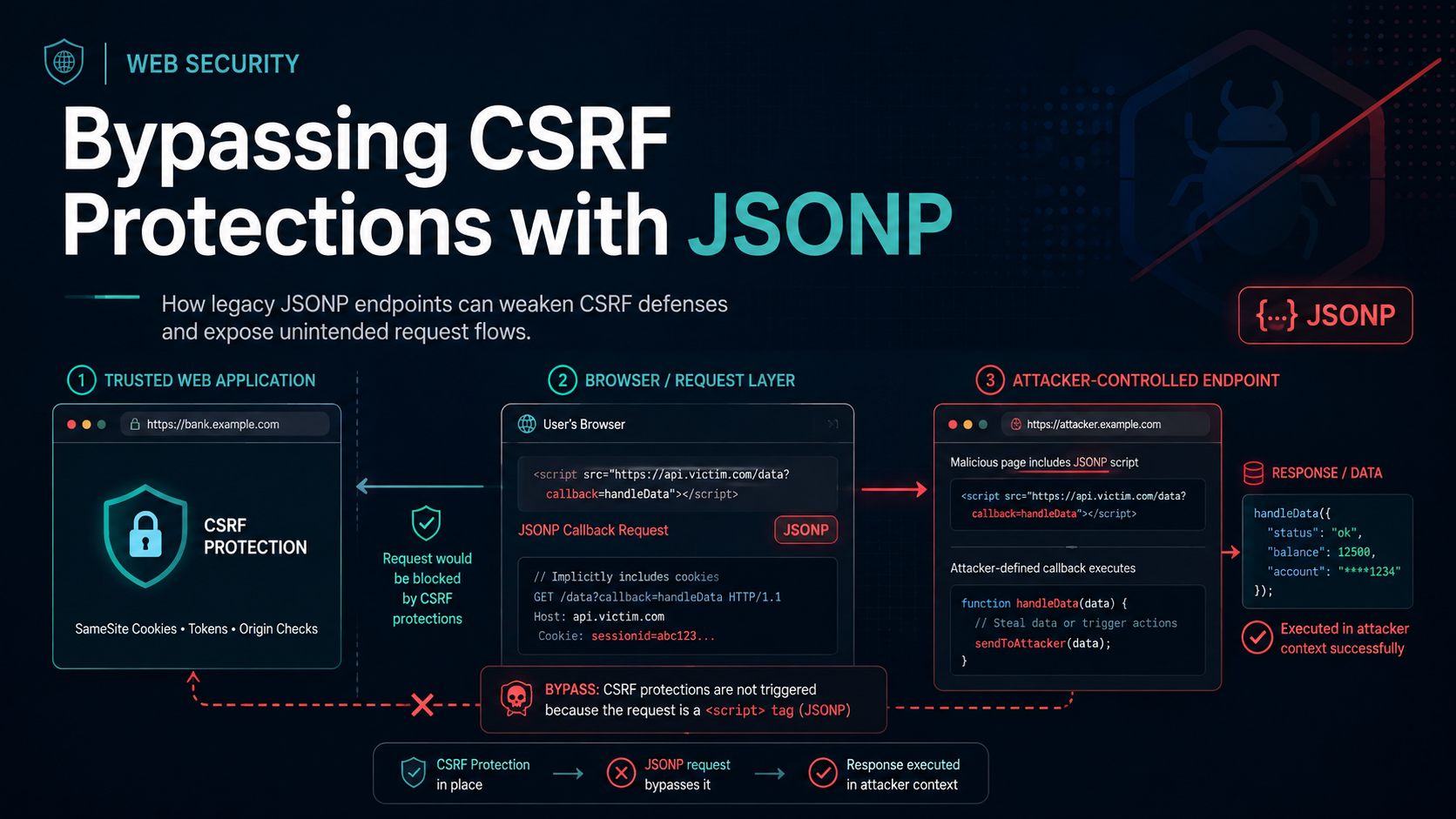
Imagine you're analyzing a web application that seems fortified against Cross-Site Request Forgery (CSRF) attacks. The developer has implemented anti-CSRF tokens effectively, rendering many traditional attack vectors ineffective. However, there's a lingering vulnerability lurking in an unexpected place—JSONP endpoints. This article will explore how attackers can exploit JSONP to bypass CSRF protections and what you can do to defend against it.
Understanding CSRF and JSONP Basics
CSRF is a type of attack that tricks a victim into submitting unwanted requests to a web application where they are authenticated. Developers typically use anti-CSRF tokens to mitigate these attacks. JSONP, or JSON with Padding, is a legacy technique to bypass the Same-Origin Policy, allowing data retrieval from another domain by dynamically injecting a <script> tag.
Consider the following JSONP request:
GET /data?callback=parseData HTTP/1.1
Host: api.example.com
When executed, this request returns a response wrapped in a JavaScript function, allowing the client to consume data across different domains.
Exploiting JSONP to Bypass CSRF Protections
JSONP endpoints can be a weak link in otherwise robust CSRF defenses. Attackers can exploit them by creating malicious web pages that leverage a victim's credentials to perform actions they did not intend. Consider this example:
<script>
function exploit() {
  var script = document.createElement('script');
  script.src = 'https://api.example.com/transfer?callback=stealFunds&amount=1000';
  document.body.appendChild(script);
}
function stealFunds(data) {
  // Malicious logic goes here
}
exploit();
</script>
This code initiates a request while the victim is authenticated, allowing the attacker to potentially execute actions on behalf of the victim.
Identifying Vulnerable Endpoints
Penetration testers and security researchers should focus on identifying endpoints that support JSONP, as these are prime candidates for bypassing CSRF protections. To detect these vulnerabilities:
- Review API documentation or in-browser network traffic for JSONP usage.
- Use tools like Burp Suite to intercept requests and test for JSONP behavior.
- Check if the server processes requests with a callback parameter.
By understanding these patterns, an attacker can craft exploits or, conversely, a defender can identify and mitigate these risks.
Defensive Measures Against JSONP Exploitation
To defend against CSRF bypass via JSONP, consider the following strategies:
- Use CORS: Replace JSONP with Cross-Origin Resource Sharing (CORS) for cross-domain requests, which is a more secure alternative.
- Implement strict input validation: Ensure callback parameters are whitelisted and strictly validated on the server.
- Deprecate JSONP: Migrate away from JSONP and use secure RESTful APIs instead.
These measures not only protect against CSRF but also enhance overall application security.
Next Steps: Secure Your Web Applications
The ability to bypass CSRF protections using JSONP highlights the importance of continuous security assessment and adopting current best practices. Developers and security teams should audit existing applications for JSONP usage and replace it with more secure alternatives. By proactively addressing these vulnerabilities, you can protect your applications from a wide range of attacks.