
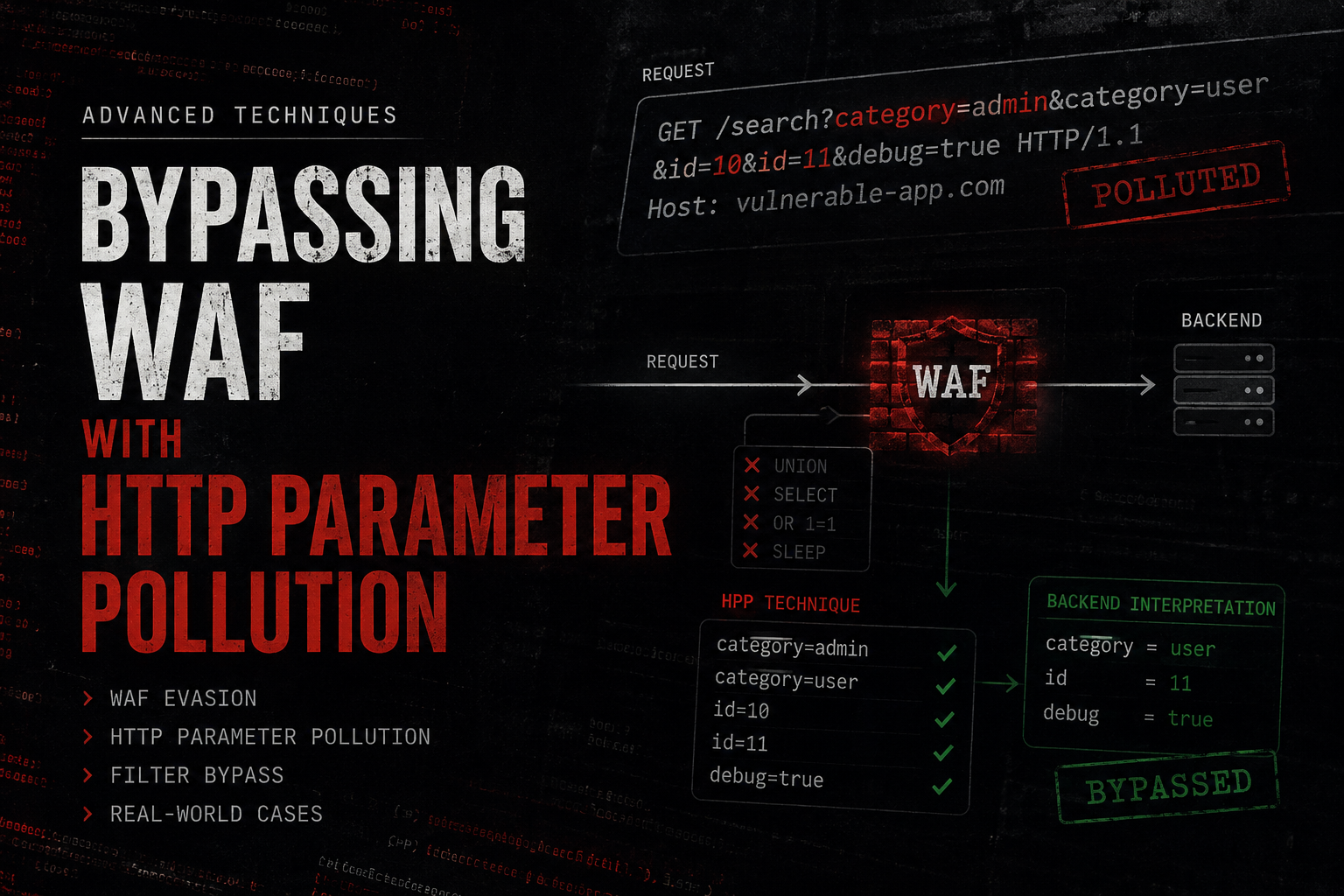
When conducting penetration testing, you might encounter robust Web Application Firewalls (WAFs) that seem impenetrable. However, often these defenses can be circumvented using lesser-known techniques like HTTP Parameter Pollution (HPP). This method involves sending multiple HTTP parameters with the same name in a request to bypass security filters and perform unexpected actions.
Understanding HTTP Parameter Pollution
HTTP Parameter Pollution exploits the way web servers handle multiple parameters with the same name. Different servers and frameworks process these parameters differently, which can lead to unexpected behavior. For example, a WAF might block a request with a single forbidden parameter but may fail to block multiple instances of the same parameter due to its parsing logic.
Consider the following request:
GET /search?query=apple&query=orange HTTP/1.1
Host: example.com
Depending on how the backend processes this, it might accept both parameters, only the first one, or the last one. This variability can be leveraged to bypass security checks.
Techniques for Exploiting HPP
To effectively use HPP to bypass WAFs, it's important to understand how different server environments handle parameter parsing. Here are some techniques:
- Detecting Parameter Behavior: Start by understanding how the target application processes repeated parameters. Use tools like Burp Suite to send requests with duplicate parameters and observe the outputs.
- Payload Crafting: Once you know the behavior, craft payloads that exploit these parsing rules. For example, if the first occurrence of a parameter is processed, inject malicious content in the first instance and benign data in the subsequent ones to evade detection.
- Understanding WAF Rules: Study the WAF's behavior by sending incremental payloads. Some WAFs might be configured to ignore parameters after the first occurrence, which can be a point of exploitation.
By carefully crafting requests, you can manipulate server processing to bypass restrictions imposed by WAFs.
Case Study: Bypassing Filter Rules
Let's consider a scenario where a WAF blocks the parameter "cmd" due to its use in command injections:
GET /execute?cmd=ls HTTP/1.1
Host: vulnerable.com
To bypass this, you could use HPP by sending:
GET /execute?cmd=benign&cmd=ls HTTP/1.1
Host: vulnerable.com
If the server processes the last occurrence of "cmd", the WAF might miss the malicious intent, allowing the command to execute.
Defensive Measures Against HPP
To protect against HPP, it is critical to ensure consistent parameter processing across your applications. Here's what defenders can do:
- Normalize Parameter Handling: Ensure your application consistently processes multiple parameters by explicitly defining which occurrence to accept, typically the first or last.
- WAF Configuration: Configure your WAF to detect and alert on requests containing duplicate parameters, as these are often indicative of HPP attempts.
- Log Analysis: Regularly analyze logs for patterns that indicate HPP attacks, such as repeated parameters in requests.
By implementing these measures, you can strengthen your defense against parameter pollution attacks.
Next Steps for Practitioners
To effectively use HTTP Parameter Pollution in your security assessments, start by familiarizing yourself with your target's server configuration and parameter handling behavior. Experiment with different permutations of parameters to identify vulnerabilities. Integrate these techniques into your testing methodologies to uncover potential bypasses in WAFs.
For defenders, consider enhancing your WAF detection rules and implementing consistent parameter parsing logic to reduce your attack surface. Regular log reviews and anomaly detection can significantly mitigate the risk of HPP attacks on your systems.