
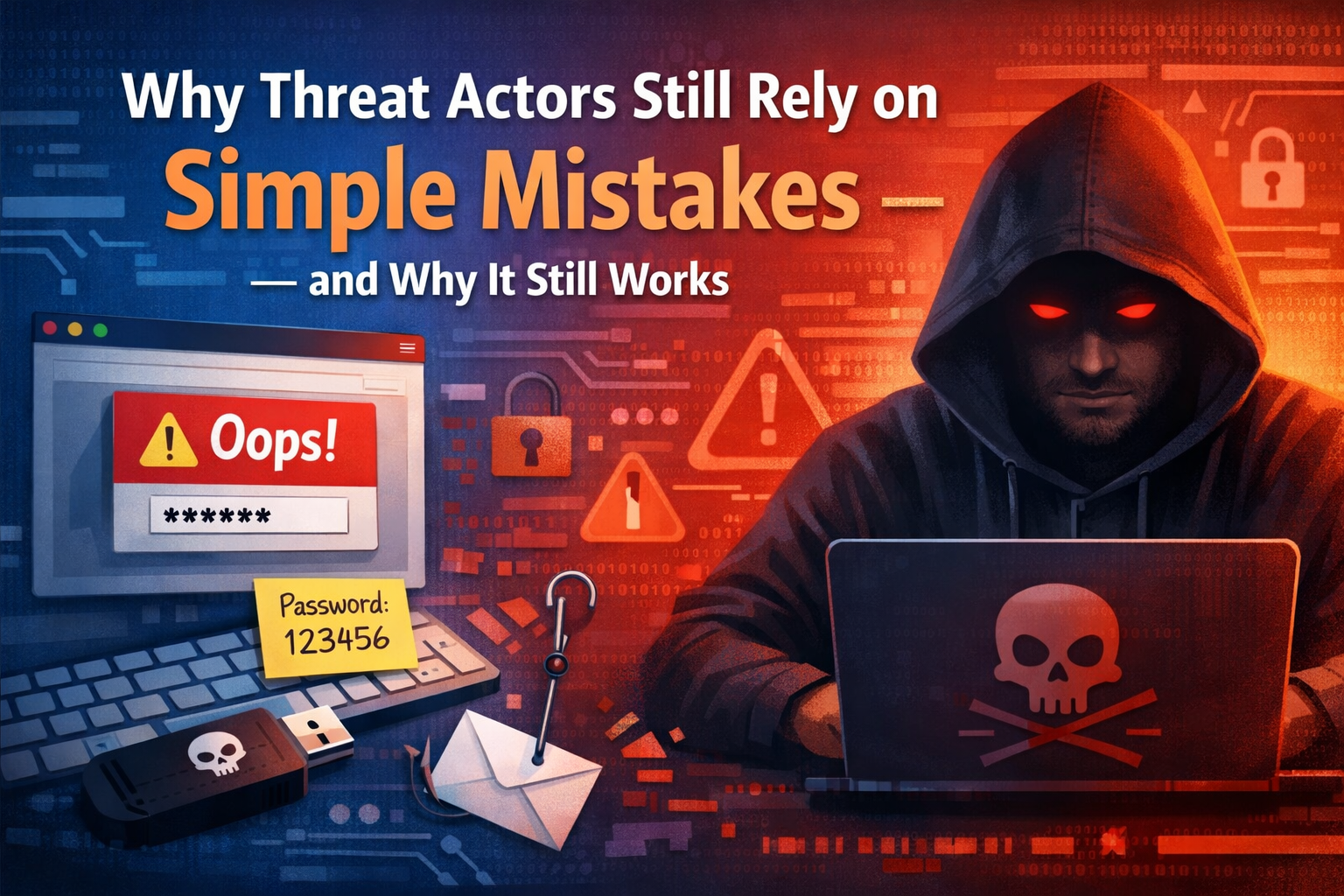
In cybersecurity, there is a persistent assumption that attacks must be complex to be effective. Zero-days, advanced malware, and sophisticated techniques often dominate headlines. Yet when real-world breach investigations are examined, the starting point is usually far more ordinary. Weak credentials, misconfigured systems, or forgotten access paths remain the most common entry points for threat actors.
This is not a sign that attackers lack skill. On the contrary, it reflects a deep understanding of how organizations actually operate.
Simple Access Is Quiet — and Silence Is Powerful

When threat actors rely on simple mistakes, they rarely trigger alarms. A successful login with correct credentials does not appear malicious. Access during business hours does not raise suspicion. Even repeated low-frequency activity can be dismissed as normal system usage.
This quiet presence allows attackers to remain inside an environment for extended periods. Many investigations reveal that early warning signs were visible in logs long before detection, but those signs were never connected into a meaningful pattern.
Human Behavior Keeps the Door Open
Technology evolves quickly, but human behavior changes slowly. Temporary solutions become permanent, shared credentials are normalized, and security controls are adjusted for convenience. These decisions are rarely malicious, yet they create conditions that attackers consistently exploit.
Threat actors do not need to defeat strong defenses if those defenses are bypassed through routine habits. In many cases, the attack is not a forced entry, but an unchallenged access that was never meant to be exposed.
Why These Methods Continue to Work
Simple mistakes persist because they align with reality. Organizations are complex, time-constrained, and imperfect. Security controls are unevenly applied, and operational priorities often outweigh preventive measures. Threat actors understand this environment and choose techniques that are reliable, repeatable, and low-risk.
The success of these methods is not rooted in novelty, but in predictability.
Conclusion
The most damaging cyber incidents rarely begin with advanced attacks. They start with small oversights that feel familiar, acceptable, or already addressed. Threat actors continue to rely on simple mistakes because those mistakes reflect how systems are actually used, not how they are designed.
In cybersecurity, the greatest risk is often not what we do not know — but what we assume has already been fixed.